
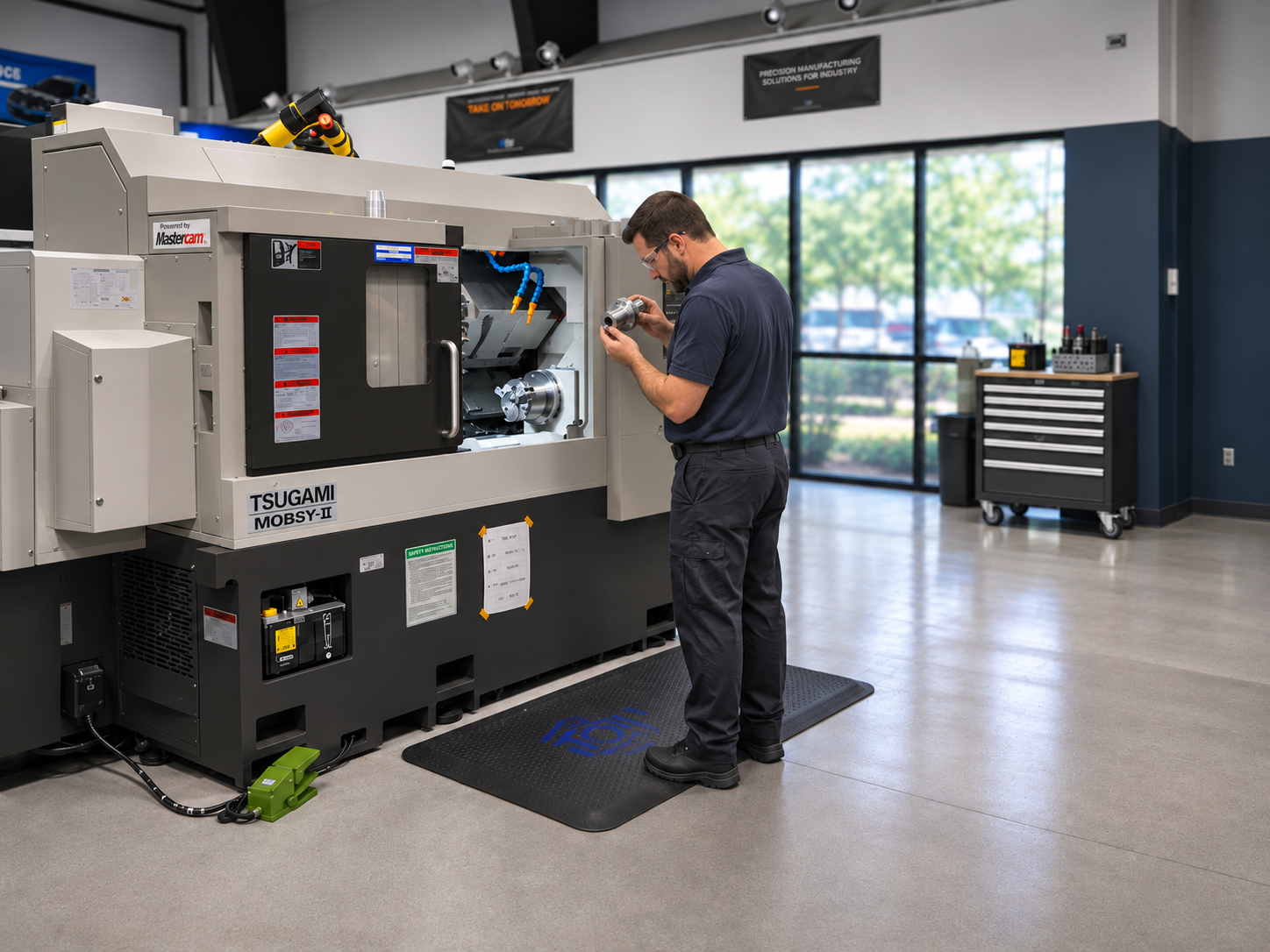
How Process Development Reduces Risk Before Production Begins
Unresolved process questions become much harder to work through once a job reaches production. At that point, the focus shifts from proving out the process to keeping parts moving. Questions around tooling access, chip evacuation, dimensional control, workholding, inspection or automation can quickly turn into adjustments at the machine, interrupted production, and additional time spent troubleshooting.
Preproduction process development gives manufacturers the opportunity to work through those variables before production time is on the line. The team can validate the operation sequence, confirm tooling and workholding strategies, evaluate how critical dimensions will be measured and controlled, and determine whether the complete process can support the expected production quantity. Working through those questions early helps protect valuable machining time and reduces the amount of trial-and-error needed on the production floor.
What Is Process Development?
Process development is the work required to turn a part requirement into an executable manufacturing process. It brings together the programming, tooling, workholding, cutting parameters, inspection strategy, and other process elements needed to manufacture the part.
How that process is developed depends on the job. Part geometry, material, machine capability, production quantity and quality requirements can all influence the approach. Development is where those factors are tested and refined until the process can reliably produce the required result. The objective is to establish a known technical starting point for production. Process development cannot eliminate every challenge that may occur once a job begins running, but it gives the production team a process that has already been tested, evaluated, and documented.
How Does Programming Reduce Production Risk?
Programming establishes how the work will move through the machine. It defines the operation sequence, toolpaths, machine movements, spindle activity, transfers and clearances required to complete the part.
A programming review can reveal potential problems before cutting begins, including:
- Difficult tool access
- Potential interference
- Unnecessary tool motion
- Inefficient operation sequencing
- Transfer or handoff concerns
- Features that require a different machining strategy
Simulation and program review are valuable development tools, but they do not replace actual machine testing. The program still needs to be proven under real cutting conditions.
The Role of Process Validation in Production Readiness.
Process validation provides evidence that a developed machining process can consistently meet the requirements established for production. Rather than looking only at whether an acceptable part can be produced, validation evaluates how the complete process performs under conditions that reflect the intended application. Process validation does not replace a manufacturer's formal quality, regulatory, or customer approval requirements. It provides technical evidence about how the machining process performs and helps manufacturers make more informed decisions as that process moves toward production.
P360 can support manufacturers by helping evaluate areas such as:
- Part quality and dimensional consistency
- Tool performance and offset management
- Program and setup stability
- Chip control and evacuation
- Part handling and planned automation
- Operator procedures and process recovery
- Documentation for production handoff
The scope of validation depends on the application and what needs to be proven. P360 can work with the manufacturer to identify those requirements, test the process, address issues that surface, and refine the approach before production.
The Benefits of Good Process Documentation.
A developed process is only valuable if the production team can carry it forward. Process documentation gives operators and setup personnel a proven starting point for running the job, making adjustments, and troubleshooting when conditions change.
Depending on the application, that handoff may include:
-
Approved CNC program
-
Tooling & Work holding Information
-
Setup Instructions
-
Offset guidance
-
Inspection points
-
Tool replacement procedures
-
Expected process changes
For a manufacturer, that can mean less reliance on tribal knowledge and fewer questions about how a job was originally intended to run. Important process information, such as the approved program, tooling and workholding, setup requirements, offsets, inspection points, and tool changes, is captured so the knowledge developed during testing isn't lost when the process reaches the shop floor.
How Tooling Strategy Affects Production.
A tooling strategy has to support more than the first successful part. That means looking at how the tooling works as part of the complete machining process. Tool life, chip control, rigidity, coolant delivery, clearance, and tool changes can all influence whether the process continues producing the required results. A tooling decision that works during an initial test may need to be adjusted once those production demands are considered.
This is where process development adds value. By evaluating tooling under conditions that more closely represent production, shops can help identify potential limitations, refine the tooling strategy, and determine how it fits into a process that can be maintained over time.
Evaluate the Workflow Through Test Cuts.
Moving a new process onto the shop floor can come with unanswered questions. Test Cuts give manufacturers an opportunity to see how a proposed machining process performs before that process reaches production.
Using Precision360 engineering resources, the process can be run and evaluated under conditions that reflect the intended application. This process highlights how the tooling, workholding, programming, cutting parameters, chip control, and other elements of the process perform together. More importantly, what is learned during the Test Cut can be used to refine the process before implementation. Potential issues can be identified, adjustments can be made, and the manufacturer can gain a clearer understanding of how the process is expected to run before bringing it onto the shop floor.
Turn The Part Print Into a Production Strategy.
A successful machining process has to do more than produce an acceptable part. That is why process development should begin with a clear understanding of the complete production requirement, not just the part print.
Before moving forward with a new process, it can be helpful to step back and consider the questions that will influence how that process needs to perform:
-
What production quantities and lot sizes are expected?
-
Which tolerances or features will be most critical to maintain?
-
How frequently will the job need to be set up or changed over?
-
What inspection, handling, or secondary operations need to be considered?
-
Where will operators need to interact with the process?
-
Will automation be part of the process now or in the future?
-
What production and delivery expectations does the process need to support?
Looking at these requirements early gives manufacturers a better foundation for making decisions around equipment, tooling, workholding, automation, inspection, and the overall machining strategy. Precision360 helps manufacturers connect part and production requirements to Tsugami technology, applications expertise, and appropriate technical resources. Starting the conversation with a print, material specification, estimated production quantity, and key quality requirements provides a stronger basis for machine evaluation and process planning.